Do you imagine yourself building something out of the ground – a house, a garden, food crops?
Do you have a passion for creating delicious meals or designing beautiful landscapes? Are you someone who gets joy out of helping others?
An apprenticeship or traineeship may give your future career a boost in the right direction. They can be full-time, part-time, or school-based.
What are apprenticeships and traineeships?
Apprenticeships and traineeships give you a way to gain real-world work experience and practical skills in the workplace. At the same time, you get formal training – all while earning money. In other words, you can earn while you learn.
You may want to be a builder, a mechanic, a chef, gardener, early-childhood educator, or computer technician. With an apprenticeship or traineeship you can dip your toe in and try it out. The workplace knowledge and skills that you gain will set you up for a career in an industry you love.
Throughout your apprenticeship or traineeship, someone at your workplace will mentor you. You will also get off-the-job training from a Registered Training Organisation (RTO). This formal training contributes towards a nationally-recognised qualification.
This all happens under a formal training contract which is between you, your workplace, and the training organisation.
What’s the difference between an Apprenticeship and a Traineeship?
As an apprentice, you’ll learn a skilled trade in a ‘traditional’ training area such as building, plumbing, or hairdressing. As well as learning in the workplace, you’ll get off-the-job training from a training organisation. An apprenticeship is usually 3.5 – 4 years long and, at the end, you’ll be a tradie with a nationally-recognised qualification.
A traineeship is almost the same thing, except in less ‘traditional’ training areas, such as business, retail, and aged care. The duration is generally shorter than an apprenticeship, with most traineeships taking between 1 – 2 years to complete.
The nationally-recognised training you receive throughout your apprenticeship or traineeship is industry-endorsed. And there are over 140 approved qualifications to choose from in Tasmania. This means you can take on an apprenticeship or traineeship in a huge range of industries.
View the full .
School-based Apprenticeships
Apprenticeships and Traineeships can be full-time, part-time, or school-based. School-based apprenticeships in DECYP schools are known as “ASbAs†– Australian School-based Apprenticeships.
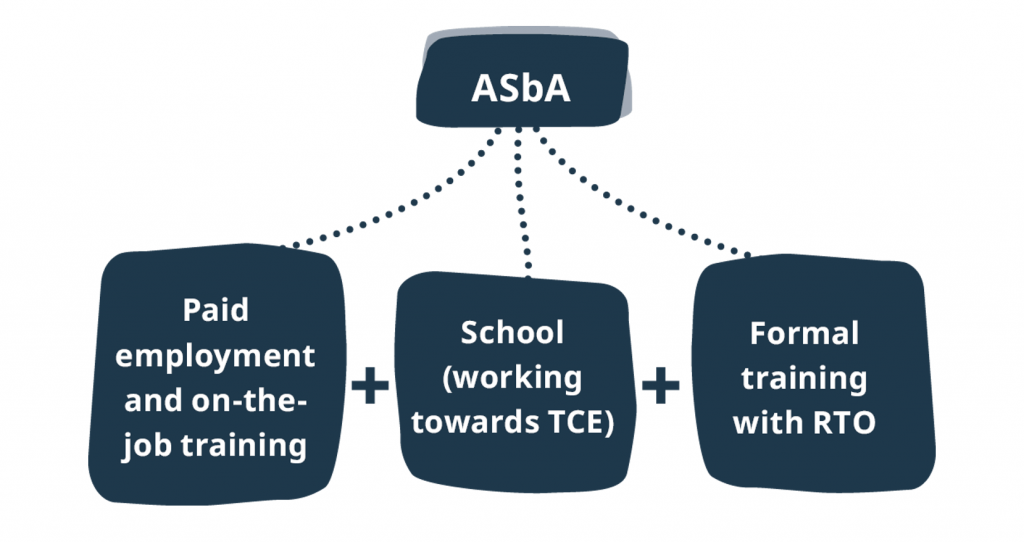
An ASbA gives you a jump start into a career while you’re still in Years 10, 11, or 12 at school. You’ll be able to combine school, employment, and training. At the end of your ASbA you’ll achieve a nationally-recognised qualification.
Throughout your ASbA, you’ll still be working towards earning your Tasmanian Certificate of Education. This means you may finish school with a TCE and a head start into your chosen career.
What level of qualification can I get through an ASbA?
The qualification you earn is usually at a Certificate II or III level. It is nationally recognised by both industry and employers.
How many hours a week will I be working?
As an ASbA student you will enter into a contract of training as an apprentice or trainee. As part of this contract, you will participate in a minimum of 7.5 hours per week. Your hours will be negotiated with your parent/guardian, employer, and your school. As an ASbA learner, you’ll be paid for the hours you work – you can use the to find out the Award rate per hour for your apprenticeship or traineeship.
Who can do an ASbA?
A school-based apprenticeship or traineeship is for learners in Years 10, 11 and 12.
A learner in Year 9 may participate in an ASbA on a case-by-case basis, however they must meet a number of conditions to do so. Talk to your teacher if you’re in Year 9 and are really keen to get started.
How does it work?
A training organisation will work with you and your ASbA employer to develop a training plan. The training plan outlines what you will be taught, and how the training will be delivered. It could be delivered online, on-the-job, or as “block training†(week or more at a time).
At your workplace, you’ll be mentored by your employer to develop industry skills and knowledge. At the same time, a Registered Training Organisation (such as TasTAFE) will provide you with the formal training needed to complete your qualification.
When you’re at school, you’ll be working towards your TCE. Your ASbA will also provide points towards your TCE (depending on the units completed as part of your ASbA).
What are the benefits of an ASbA?
- Earn money while training
- Get on-the-job training and experience
- Gain the possibility of full-time employment
- Gain points towards TCE
- Complete a nationally recognised qualification
- Continuing into higher education/qualification upon completion of an ASbA
I’m interested. What’s the next step?
The best starting point is to talk to your parent or carer, as well as a supportive teacher.
You can then find an employer that will take on an Apprentice or Trainee. This could be through an online job advertisement, word-of-mouth, or talking to local businesses or your current place of employment.
Next, you should talk to your school and its Apprenticeship and Traineeship (ApTSL) Facilitator. They will help you understand the rest of the process.
At any point, our Apprenticeships and Traineeships for School-aged Learners (ApTSL) team is available to help. We can be contacted on asba.admin@decyp.tas.gov.au or 03 6165 5404,
For employers
Information for Businesses
ASbA Booklet for employers –
If you’re a Tasmanian business wanting to put on an apprentice or trainee, please contact the ApTSL team on 03 6165 5404.