Key information
- In Tasmania a significant number of children aged birth to 12 years attend Education and Care services.
- Education and Care services comprise:
- Long Day Care
- Outside School Hours Care, including Before and After School Care and Vacation Care
- Family Day Care
- Occasional Care
- The shows how we work together.
A Framework for partnerships
The shows how the 91黑料 (DECYP), Education and Care (EC) providers and children and families work together in partnership.
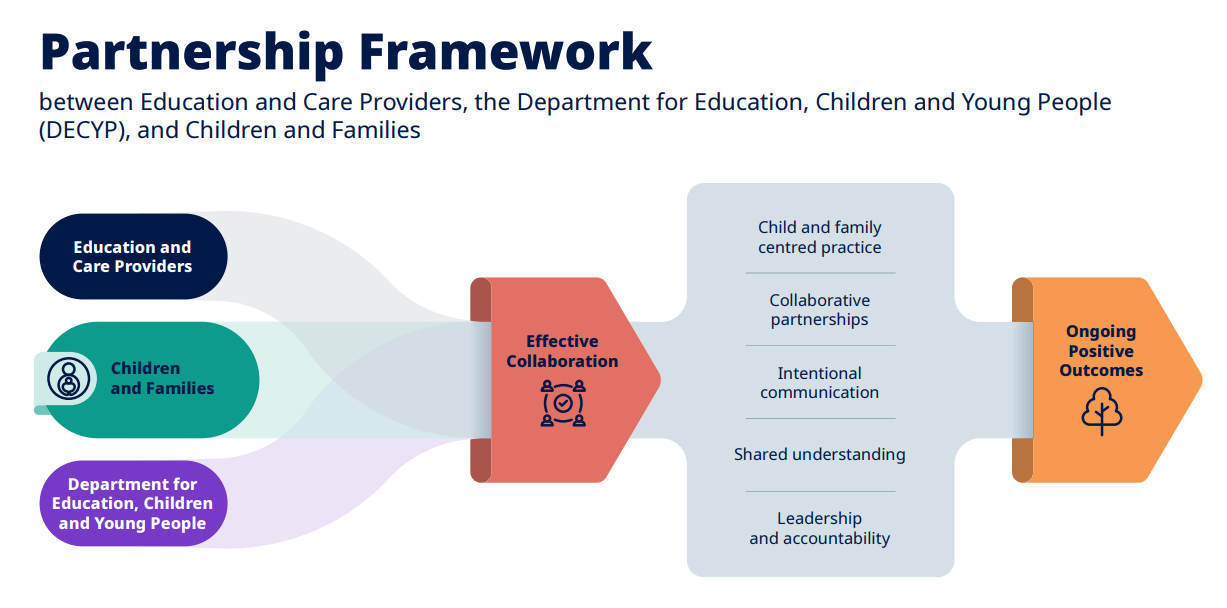
Through our partnership we contribute to the shared vision for Tasmanian children.
Education and Care services
Education and Care services comprise:
- Long Day Care (LDC)
- Outside School Hours Care (OSHC), including Before and After School Care and Vacation Care
- Family Day Care (FDC)
- Occasional Care services.
The Australian ECEC sector has experienced a period of significant growth and development in the last decade. In 2009 (and updated in 2022) was introduced for all early childhood settings.
The , introduced in 2012, is designed to ensure a uniform and integrated approach to the regulation and quality assessment of education and care services across Australia. A national body, , guides and monitors the implementation of the NQF to promote consistency across all states and territories. In Tasmania, the NQF is administered and monitored by the 91黑料 (DECYP) .
Co-location arrangements
What is Co-location?
Co-location is where Education and Care (EC) services run on 91黑料 (DECYP) sites. Sites such as schools or Child and Family Learning Centres (CFLCs).
Two examples of co-location are:
- A Long Day Care (LDC) centre in a building leased on a school site.
- Outside School Hours Care (OSHC) using shared facilities, like a school hall.
Partnership is the key to successful co-location relationships between DECYP and EC providers in Tasmania. The and , along with the , help support and guide these relationships, encouraging strong and effective connections built on mutual commitment and collaboration.
Required meetings between DECYP and the EC provider
The , requires DECYP to meet with co-located EC providers. These meetings must be between decision makers from both sectors. DECYP Principals or School Business Managers and EC Leaders must attend. These meetings are opportunities to organise shared activities and discuss challenges. They also assist in the planning of transitions for children between the EC service and DECYP settings.
The required meeting cycle is:
- Minimum meetings three times per year with Outside School Hours Care, Family Day Care, Occasional Care
- Minimum meetings two times per year with Long Day Care services.
The outlines meeting requirements where DECYP and EC providers are encouraged to meet informally and communicate regularly, as suitable to the individual context.
Communication
Communication is a critical tool for achieving strong partnerships. In this context, it involves:
- keeping the best interests of children at the centre
- being open and respectful
- listening to understand differing perspectives
- communicating messages clearly and concisely
- using nonverbal visual cues to convey respect
- selecting the right form of communication
It is an expectation under the and that co-located services communicate frequently, openly and respectfully.
Legislation, Policy and Procedure
91黑料 (DECYP) schools and services, and Education and Care (EC) services are regulated and guided by a range of different legislation, policies and processes. Sometimes they are the same; sometimes they differ. It is important to understand the context of each other鈥檚 operating environment to ensure we can work together effectively to improve the education and wellbeing of our children.
The , has important overarching information for DECYP school and service and EC service staff.
Working in partnership is an active and ongoing process. DECYP schools and services, and EC services need to build strong and collaborative relationships to achieve positive outcomes for children. The and guide co-location of EC and DECYP services and frames this by providing clear and consistent guidance.
Resources
Frameworks
Templates
Guides